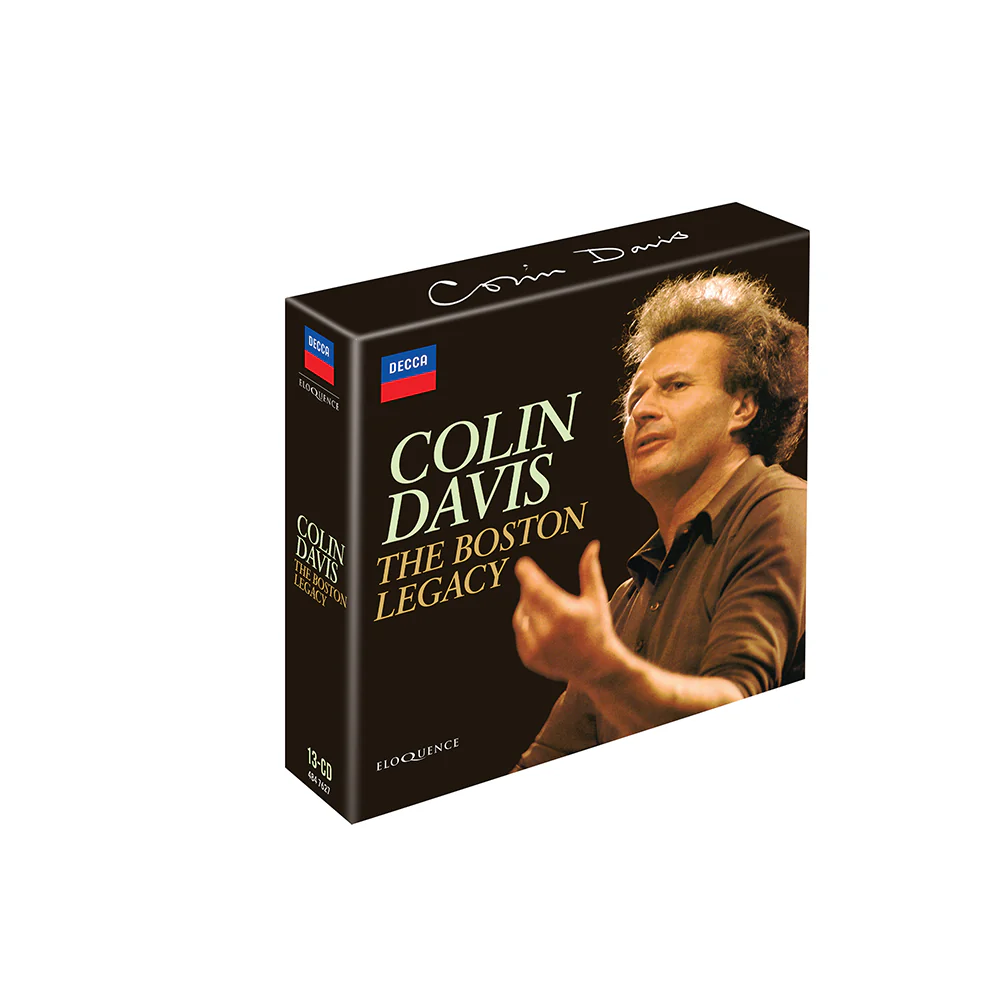
Colin Davis – The Boston Legacy (13CD Box Set)
Reissued complete for the first time, the recorded legacy of Sir Colin Davis and the Boston Symphony Orchestra on Philips, including an unsurpassed cycle of Sibelius symphonies.
Each element of the tricky chemistry came off when Colin Davis made his debut with the Boston Symphony Orchestra in 1967, in concerts of Berlioz, Stravinsky and Dvořák. In search of a new Principal Conductor at the time, the BSO offered the post to Davis, but he preferred to focus his energies on the directorship of the Royal Opera in London. However, he began making regular return visits to Boston, and in 1974 became the orchestra’s Principal Guest Conductor.
As the most ‘European’-sounding of the great American orchestras, the BSO responded with natural affinity to Davis’s sense of line and cultivated warmth in canon repertoire. When he began to explore Sibelius with them, both the orchestra and audience responded with cautious curiosity which blossomed into committed enthusiasm. Philips capitalised on this affinity by recording them together in the complete symphonies and selected tone-poems between 1975 and 1980, successfully capturing the intensity of the associated concerts.
While the Sibelius cycle has maintained a firm place in the catalogue, other albums in the BSO/Davis discography have fallen from prominence. They include a fizzing Mendelssohn album of the ‘Italian’ Symphony and excerpts from A Midsummer Night’s Dream; a delectably sprung set of excerpts from Schubert’s Rosamunde, and one of the first-ever versions of the ‘Great’ C major Symphony to include all the repeats.
Davis had a long-established harmonious working relationship with Claudio Arrau, and the Chilean pianist came to Boston to record magisterial, lovingly detailed versions of the concertos by Schumann, Grieg and Tchaikovsky. While Tchaikovsky is hardly a name associated with Davis, the conductor also drew remarkable tension, energy and volume from his Boston forces in Romeo and Juliet and the 1812 Overture.
Product Information
Product Information
Shipping & Returns
Shipping & Returns
Description
Reissued complete for the first time, the recorded legacy of Sir Colin Davis and the Boston Symphony Orchestra on Philips, including an unsurpassed cycle of Sibelius symphonies.
Each element of the tricky chemistry came off when Colin Davis made his debut with the Boston Symphony Orchestra in 1967, in concerts of Berlioz, Stravinsky and Dvořák. In search of a new Principal Conductor at the time, the BSO offered the post to Davis, but he preferred to focus his energies on the directorship of the Royal Opera in London. However, he began making regular return visits to Boston, and in 1974 became the orchestra’s Principal Guest Conductor.
As the most ‘European’-sounding of the great American orchestras, the BSO responded with natural affinity to Davis’s sense of line and cultivated warmth in canon repertoire. When he began to explore Sibelius with them, both the orchestra and audience responded with cautious curiosity which blossomed into committed enthusiasm. Philips capitalised on this affinity by recording them together in the complete symphonies and selected tone-poems between 1975 and 1980, successfully capturing the intensity of the associated concerts.
While the Sibelius cycle has maintained a firm place in the catalogue, other albums in the BSO/Davis discography have fallen from prominence. They include a fizzing Mendelssohn album of the ‘Italian’ Symphony and excerpts from A Midsummer Night’s Dream; a delectably sprung set of excerpts from Schubert’s Rosamunde, and one of the first-ever versions of the ‘Great’ C major Symphony to include all the repeats.
Davis had a long-established harmonious working relationship with Claudio Arrau, and the Chilean pianist came to Boston to record magisterial, lovingly detailed versions of the concertos by Schumann, Grieg and Tchaikovsky. While Tchaikovsky is hardly a name associated with Davis, the conductor also drew remarkable tension, energy and volume from his Boston forces in Romeo and Juliet and the 1812 Overture.