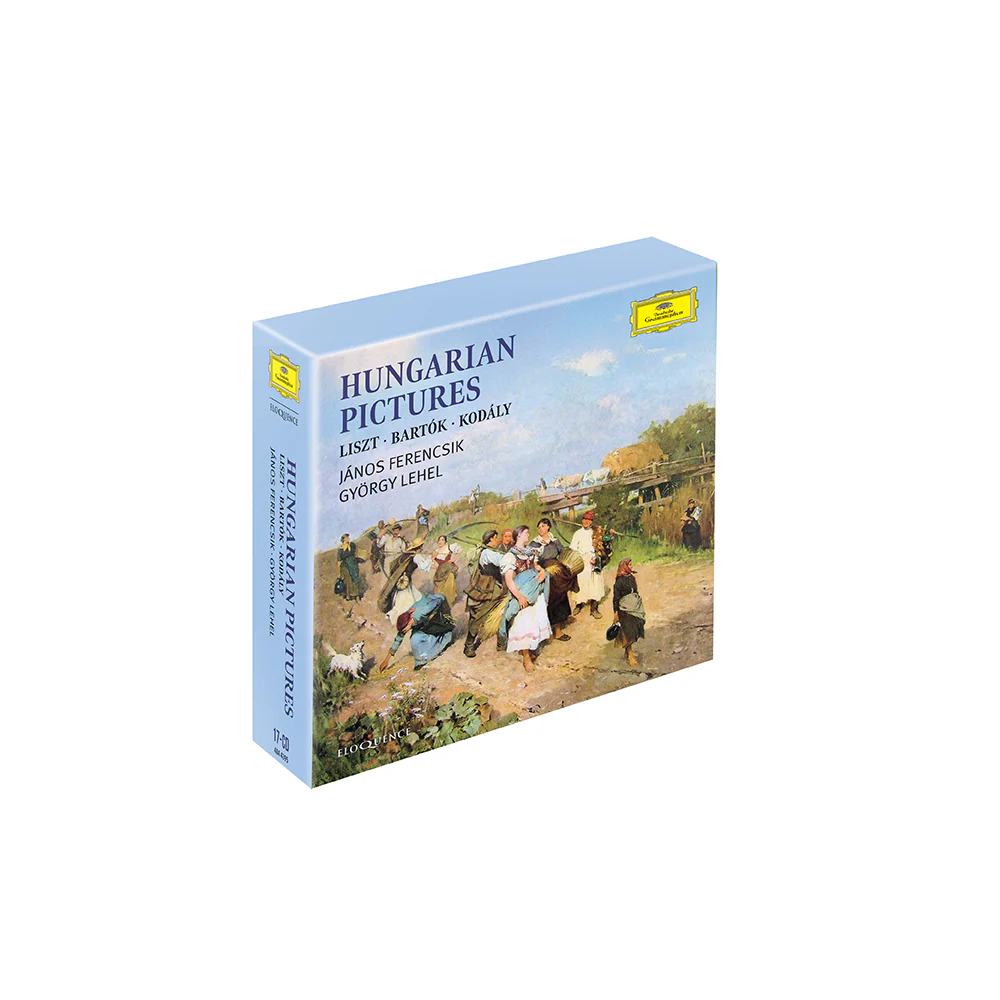
Hungarian Pictures (17CD Box Set)
Hungarian Pictures presents recordings of music by Liszt, Bartók, Kodály and Dohnányi in recordings of native authority, many of them making their first appearance on CD. János Ferencsik and György Lehel were leading orchestras who knew their style intimately, and who had the Hungarian rhythms of this music flowing in their blood.
In the 1960s, Deutsche Grammophon and the Westminster label introduced listeners to much fascinating Hungarian repertoire which they had never previously encountered. This Eloquence set of ‘Hungarian Connections’ gathers up these rare recordings for the first time and reissues them in newly remastered versions with original covers.
A booklet essay by Peter Quantrill explores the careers of the two principal musicians leading the music-making on the set, János Ferencsik and György Lehel. These were both conductors who did not flee Hungary when the revolution was so brutally suppressed by the Communists in 1956. Accordingly, they came to play a central role in musical culture in postwar Budapest, with Ferencsik based at the Opera and Lehel at the Radio and TV company.
Ferencsik and Lehel were leading orchestras who knew their style intimately, and who had the Hungarian rhythms of this music flowing in their blood: Ferencsik remarked that he performed Bartók’s music as naturally as if he were breathing. No less compelling is the single album issued by DG of Kodaly conducting his own music, which introduced the shimmeringly evocative tone-poem Summer Evening to many western listeners.
Finally, there is a single LP of highlights from the 1961 Liszt-Bartok Piano Competition, held in Budapest: the winner Gábor Gabos gives a thunderously eloquent account of Liszt’s Piano Sonata, and there are further performances by the young Dino Ciani, Valentin Belchenko and David Wilde.
Original: $107.13
-65%$107.13
$37.50Product Information
Product Information
Shipping & Returns
Shipping & Returns
Description
Hungarian Pictures presents recordings of music by Liszt, Bartók, Kodály and Dohnányi in recordings of native authority, many of them making their first appearance on CD. János Ferencsik and György Lehel were leading orchestras who knew their style intimately, and who had the Hungarian rhythms of this music flowing in their blood.
In the 1960s, Deutsche Grammophon and the Westminster label introduced listeners to much fascinating Hungarian repertoire which they had never previously encountered. This Eloquence set of ‘Hungarian Connections’ gathers up these rare recordings for the first time and reissues them in newly remastered versions with original covers.
A booklet essay by Peter Quantrill explores the careers of the two principal musicians leading the music-making on the set, János Ferencsik and György Lehel. These were both conductors who did not flee Hungary when the revolution was so brutally suppressed by the Communists in 1956. Accordingly, they came to play a central role in musical culture in postwar Budapest, with Ferencsik based at the Opera and Lehel at the Radio and TV company.
Ferencsik and Lehel were leading orchestras who knew their style intimately, and who had the Hungarian rhythms of this music flowing in their blood: Ferencsik remarked that he performed Bartók’s music as naturally as if he were breathing. No less compelling is the single album issued by DG of Kodaly conducting his own music, which introduced the shimmeringly evocative tone-poem Summer Evening to many western listeners.
Finally, there is a single LP of highlights from the 1961 Liszt-Bartok Piano Competition, held in Budapest: the winner Gábor Gabos gives a thunderously eloquent account of Liszt’s Piano Sonata, and there are further performances by the young Dino Ciani, Valentin Belchenko and David Wilde.