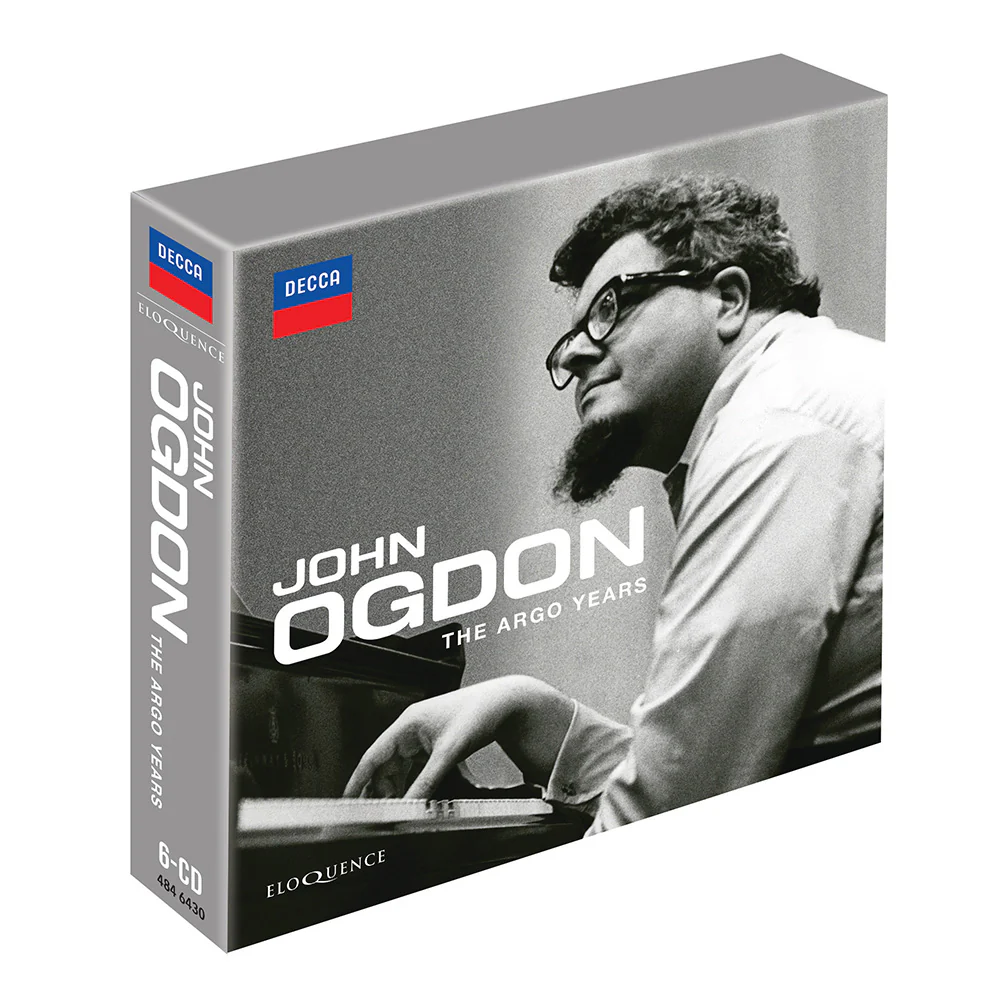
John Ogdon – The Argo Years (6CD Box Set)
Scintillating pianism in music from Mozart to Messiaen: the complete Argo and Decca recordings of John Ogdon.
John Ogdon began to study at the Royal Northern College of Music in 1953, at the age of 16. Fellow students such as Alexander Goehr and Harrison Birtwistle were astonished by the speed of Ogdon’s mind, matched by his facility at the keyboard. He could perform and make sense of the most complex scores, old and new, as though they were child’s play. Further study elsewhere led to his triumph at the Moscow Tchaikovsky Competition in 1962, when he shared the gold medal with Vladimir Ashkenazy.
He began to record for Decca six years later, in December 1968, with the piano cycle by Olivier Messiaen, Vingt Regards sur l’enfant-Jesus, which renewed the Lisztian tradition of pianism for a new postwar age. Over the next three years he made four further albums for Decca, three of them with his wife Brenda Lucas. The diversity of repertoire testifies to the range of Ogdon’s musical talent and intellectual curiosity. More elevated but virtuosic Messiaen (the Visions de l’Amen) sits alongside freewheeling youthful concertos by Mendelssohn and Shostakovich.
Almost unknown at the time that Ogdon and Lucas recorded it for Argo in 1972, the Concerto pathétique is a two-piano version, made by Liszt in 1856, of a piece which had begun life as a Grand Solo de concert in 1849. Latterly taken up by the likes of Martha Argerich, the Concerto presents a heroic contrast on record with the restraint of the Six Canons and the poetic Andante and Variations by Schumann.
Ogdon’s career, both in public and on record, was brought to a sudden and tragic halt by a breakdown in 1973. Struggling with mental health for the rest of his life, he nonetheless returned to the studios briefly in June 1983, to contribute to a Decca set of Mozart’s complete music for solo horn, led by Barry Tuckwell. In 1784, Mozart wrote to his father Leopold that the Quintet for Piano and Winds was ‘the best thing I have yet written’; Ogdon, Tuckwell and their distinguished colleagues lean into its mellow warmth while relishing the interplay of texture in Decca’s demonstration-quality sound.
Original: $49.99
-65%$49.99
$17.50Product Information
Product Information
Shipping & Returns
Shipping & Returns
Description
Scintillating pianism in music from Mozart to Messiaen: the complete Argo and Decca recordings of John Ogdon.
John Ogdon began to study at the Royal Northern College of Music in 1953, at the age of 16. Fellow students such as Alexander Goehr and Harrison Birtwistle were astonished by the speed of Ogdon’s mind, matched by his facility at the keyboard. He could perform and make sense of the most complex scores, old and new, as though they were child’s play. Further study elsewhere led to his triumph at the Moscow Tchaikovsky Competition in 1962, when he shared the gold medal with Vladimir Ashkenazy.
He began to record for Decca six years later, in December 1968, with the piano cycle by Olivier Messiaen, Vingt Regards sur l’enfant-Jesus, which renewed the Lisztian tradition of pianism for a new postwar age. Over the next three years he made four further albums for Decca, three of them with his wife Brenda Lucas. The diversity of repertoire testifies to the range of Ogdon’s musical talent and intellectual curiosity. More elevated but virtuosic Messiaen (the Visions de l’Amen) sits alongside freewheeling youthful concertos by Mendelssohn and Shostakovich.
Almost unknown at the time that Ogdon and Lucas recorded it for Argo in 1972, the Concerto pathétique is a two-piano version, made by Liszt in 1856, of a piece which had begun life as a Grand Solo de concert in 1849. Latterly taken up by the likes of Martha Argerich, the Concerto presents a heroic contrast on record with the restraint of the Six Canons and the poetic Andante and Variations by Schumann.
Ogdon’s career, both in public and on record, was brought to a sudden and tragic halt by a breakdown in 1973. Struggling with mental health for the rest of his life, he nonetheless returned to the studios briefly in June 1983, to contribute to a Decca set of Mozart’s complete music for solo horn, led by Barry Tuckwell. In 1784, Mozart wrote to his father Leopold that the Quintet for Piano and Winds was ‘the best thing I have yet written’; Ogdon, Tuckwell and their distinguished colleagues lean into its mellow warmth while relishing the interplay of texture in Decca’s demonstration-quality sound.